
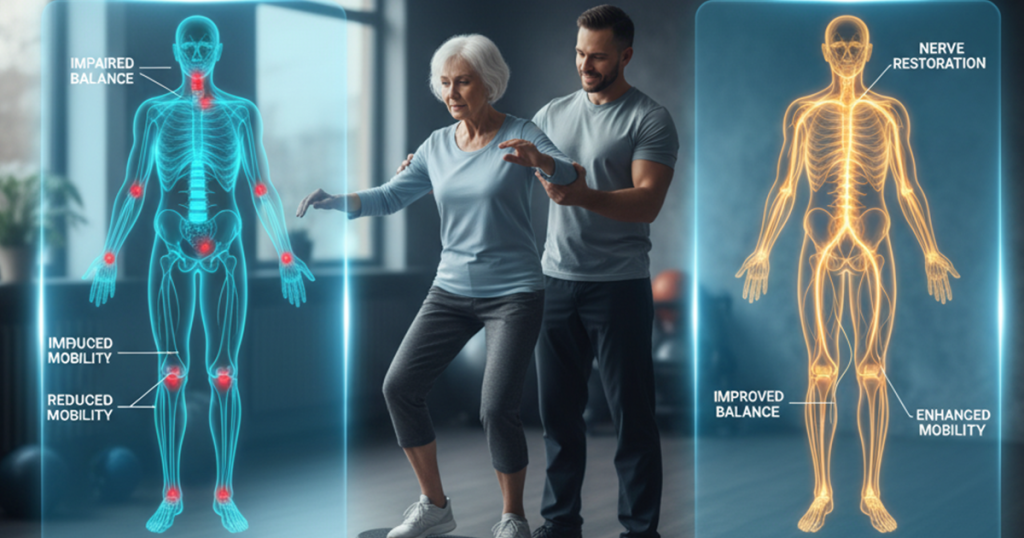
The Hidden Connection Between Nerves and Balance
Your sense of balance depends on more than just muscles and joints—it relies on healthy nerve communication. Nerves in your feet constantly send messages to your brain about pressure, position, and movement. When neuropathy disrupts those signals, your body loses awareness of where it is in space, making walking unstable and increasing the risk of falls.
At Premier Health Institute Los Angeles, we help patients restore balance and mobility by reactivating nerve function and improving circulation to the legs and feet. The result is renewed stability, confidence, and freedom of movement.
Why Neuropathy Disrupts Coordination
Peripheral nerves are like communication cables between the brain and body. They control movement, sensation, and muscle reflexes. When neuropathy damages these nerves, the brain receives incomplete or distorted feedback.
This breakdown leads to:
- Difficulty walking on uneven surfaces
- Frequent stumbling or unsteadiness
- Poor posture or slow reaction times
- Muscle weakness in the legs or ankles
- Fear of falling and reduced confidence
Without treatment, this loss of coordination worsens over time, limiting independence and daily activity.
The Science Behind Balance Recovery
Balance is controlled by three systems working together:
- The Visual System – your eyes send information about your environment.
- The Vestibular System – located in the inner ear, it helps detect motion and orientation.
- The Proprioceptive System – your nerves send data from muscles, joints, and skin to your brain.
Neuropathy primarily affects proprioception—the body’s ability to sense where your feet are without looking. When oxygen and circulation are restored, these signals come back online, and balance naturally improves.
Patient Story: Walking Without Fear Again
A 70-year-old Los Angeles patient arrived at our clinic using a cane. He described feeling like he was “walking on pillows” because he couldn’t feel the ground beneath his feet. After ten weeks of circulation, oxygen, and balance therapy, his sensation returned, and he was able to walk without assistance.
He said, “For the first time in years, I trust my legs again.”
How We Restore Balance and Mobility
Our Circulation & Balance Therapy retrains the nerves, muscles, and brain to work together again. The process includes:
- Oxygen Therapy to supply energy to nerves and muscles.
- Circulation Therapy to reopen capillaries and enhance oxygen delivery.
- Red-Light Therapy to repair nerve fibers and improve communication speed.
- Balance Stimulation Training to reeducate the body on coordination and reflex control.
- Vagus Nerve Activation to reduce inflammation and stabilize the nervous system.
This combination doesn’t just relieve symptoms—it rebuilds the body’s entire communication network for movement.
The Role of Oxygen and Circulation
Healthy circulation is the foundation of balance recovery. When oxygen-rich blood flows freely to the legs and feet, muscles regain strength and endurance. Improved oxygenation also helps the nerves that control movement send faster, more accurate signals.
Many patients notice they can stand longer, walk farther, and move with greater ease after just a few weeks of therapy.
Red-Light Therapy and Nerve Activation
Red-light therapy accelerates nerve regeneration, helping damaged nerves reconnect with the brain. As those connections rebuild, coordination improves naturally. Patients often report that they “feel the floor again,” a clear sign that proprioceptive feedback has returned.
Why Strength Alone Isn’t Enough
Traditional physical therapy focuses on muscle strength, but if the nerves aren’t firing correctly, strong muscles won’t solve the problem. That’s why our program focuses on reestablishing nerve-to-brain communication first—because once the signal returns, balance follows.
Tips for Maintaining Balance at Home
- Practice standing on one foot for 15–30 seconds daily.
- Walk slowly on varied surfaces to retrain foot awareness.
- Stretch the calves and ankles to improve mobility.
- Stay hydrated and maintain blood flow.
- Use proper footwear with stable, supportive soles.
- Avoid walking barefoot on hard floors if your feet are numb.
Frequently Asked Questions
Can neuropathy-related balance issues improve?
Yes. By restoring nerve function and circulation, most patients regain stability and confidence.
Is balance therapy safe for older adults?
Absolutely. Our methods are gentle, non-invasive, and tailored to every mobility level.
How long does it take to see improvement?
Many patients notice better stability and coordination within 4–8 weeks of consistent therapy.
The Takeaway
Neuropathy doesn’t have to take away your balance or independence. When oxygen, circulation, and nerve communication are restored, your body can move with confidence again.
At Premier Health Institute Los Angeles, our specialized neuropathy and balance program helps patients regain stability, reduce fall risk, and walk freely again—without surgery or medication.