
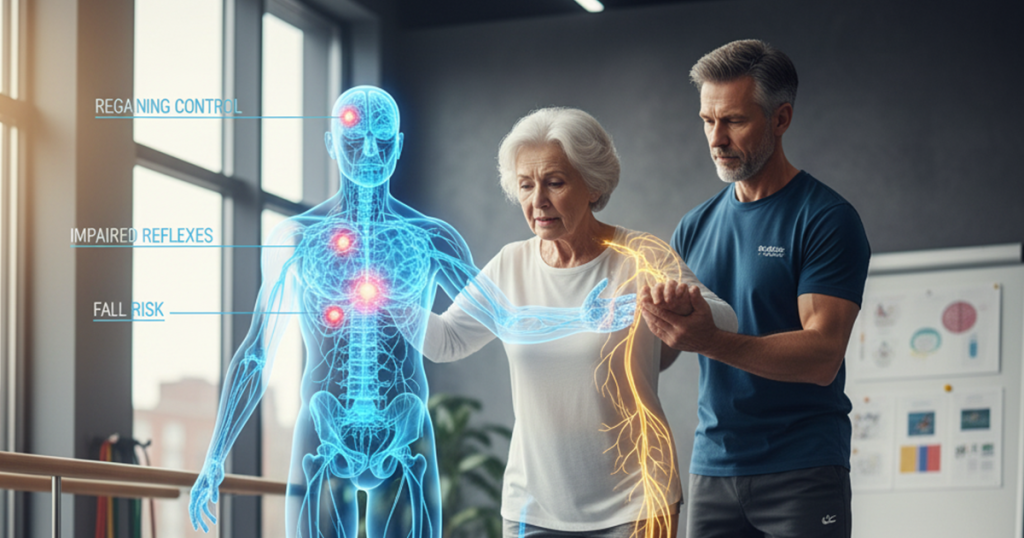
Why Nerve Health Controls Balance and Stability
Balance is not just about muscle strength—it’s about communication. Every step you take relies on millions of tiny nerve signals traveling between your feet, legs, spine, and brain. When those signals weaken due to neuropathy, your body loses awareness of its position in space, making you unsteady, slow to react, and more prone to falls.
At Premier Health Institute Los Angeles, we help patients restore balance by repairing nerve communication and improving circulation. Once oxygen and energy reach those damaged nerve pathways again, coordination returns, and confidence follows.
How Neuropathy Disrupts Reflexes and Movement
Peripheral nerves carry sensory information to your brain and motor commands back to your muscles. When nerve fibers are damaged, these signals become distorted or stop entirely. That breakdown causes several dangerous effects:
- Delayed Reflexes: Your brain reacts slower to movement, increasing fall risk.
- Poor Coordination: Muscles don’t receive accurate timing signals.
- Unsteady Gait: You may feel like you’re walking on cotton or “floating.”
- Reduced Awareness: Loss of proprioception makes it hard to sense where your feet are.
- Muscle Weakness: Without nerve input, muscles gradually atrophy.
Even mild neuropathy can subtly alter balance and posture long before pain or numbness appear.
The Role of Oxygen in Restoring Reflex Function
Reflexes depend on healthy, oxygen-rich nerves. Without oxygen, nerve cells cannot produce the energy (ATP) needed to transmit signals effectively. Over time, this oxygen starvation causes reflexes to slow, reaction times to lengthen, and coordination to falter.
Our Oxygen Therapy sessions saturate the blood with high levels of oxygen, re-energizing the cells that control reflexes, balance, and motion. Patients often describe feeling lighter, more stable, and more in control of their movements within weeks.
Patient Story: From Instability to Confidence
A 73-year-old Los Angeles patient came to our clinic after multiple falls caused by neuropathy-related balance loss. He felt “disconnected” from his feet and struggled to stand without swaying. After six weeks of combined circulation, red-light, and balance therapy, his coordination improved dramatically.
He said, “It feels like my body and brain are finally talking again.”
Today, he walks confidently without assistance—a powerful reminder that nerve function can be restored with the right approach.
How Premier Health Institute Restores Control
Our balance recovery system targets all the factors that affect nerve communication:
- Oxygen Therapy – supplies the oxygen nerves need to function.
- Circulation Therapy – reopens microcapillaries to improve blood flow to extremities.
- Red-Light Therapy – stimulates nerve regeneration at the cellular level.
- Vagus Nerve Activation – reduces inflammation and improves brain-body communication.
- Balance and Coordination Training – retrains reflexes and muscle response.
This combination reawakens both the sensory and motor sides of the nervous system—rebuilding coordination from the inside out.
Why Reflex Loss Increases Fall Risk
Reflexes are automatic responses that protect you from injury. For example, when you trip, your foot should instantly lift to catch your balance. Neuropathy slows that signal, so by the time your brain realizes what’s happening, it’s too late.
That split-second delay explains why patients with neuropathy are five times more likely to fall. Restoring nerve communication through oxygen and circulation therapy can dramatically reduce this risk.
Early Signs of Reflex Decline
If you notice any of the following, it’s a sign your reflexes are weakening:
- Difficulty standing still without wobbling
- Trouble walking in the dark or on uneven ground
- Needing to look at your feet while walking
- Slower reaction when catching yourself from tripping
- A heavy or disconnected feeling in your legs
These symptoms mean your nerves are struggling to send information quickly enough—and early treatment can help reverse it.
The Role of Balance Therapy
Our Balance Therapy Program strengthens the connection between nerves, muscles, and the brain. Using gentle motion and proprioceptive training, we retrain reflexes to respond automatically again. Combined with oxygen and red-light therapy, this leads to measurable improvements in posture, gait, and overall safety.
Supporting Balance Recovery at Home
- Practice mindful walking: Focus on heel-to-toe movement and even steps.
- Stretch daily: Keeps muscles and joints flexible.
- Hydrate regularly: Improves blood viscosity and circulation.
- Wear supportive shoes: Avoid thin soles or flip-flops.
- Use gentle core exercises: Builds stability and body awareness.
Frequently Asked Questions
Can balance and reflexes really return after nerve damage?
Yes. Once circulation and oxygen flow improve, nerves can regenerate and retrain their communication pathways.
How long does it take to regain stability?
Many patients notice progress within 4–6 weeks, with continued improvement through ongoing therapy.
Is this program safe for older adults?
Absolutely. Our therapies are non-invasive, comfortable, and tailored for all mobility levels.
The Takeaway
Nerve damage doesn’t have to mean loss of balance or independence. When oxygen, circulation, and communication are restored, your body can regain control, coordination, and safety naturally.
At Premier Health Institute Los Angeles, we specialize in helping patients rebuild stability and confidence—by treating the root cause of balance problems, not just the symptoms.